
Cross-border payment & settlement platform
Multi-currency payments, automated reconciliation and risk control.
Payment Integration
Challenge
The client ran multiple upstream payment channels with tens of thousands of daily transactions reconciled by hand — error-prone, T+3 settlement, and no real-time view of risk exposure.
Solution
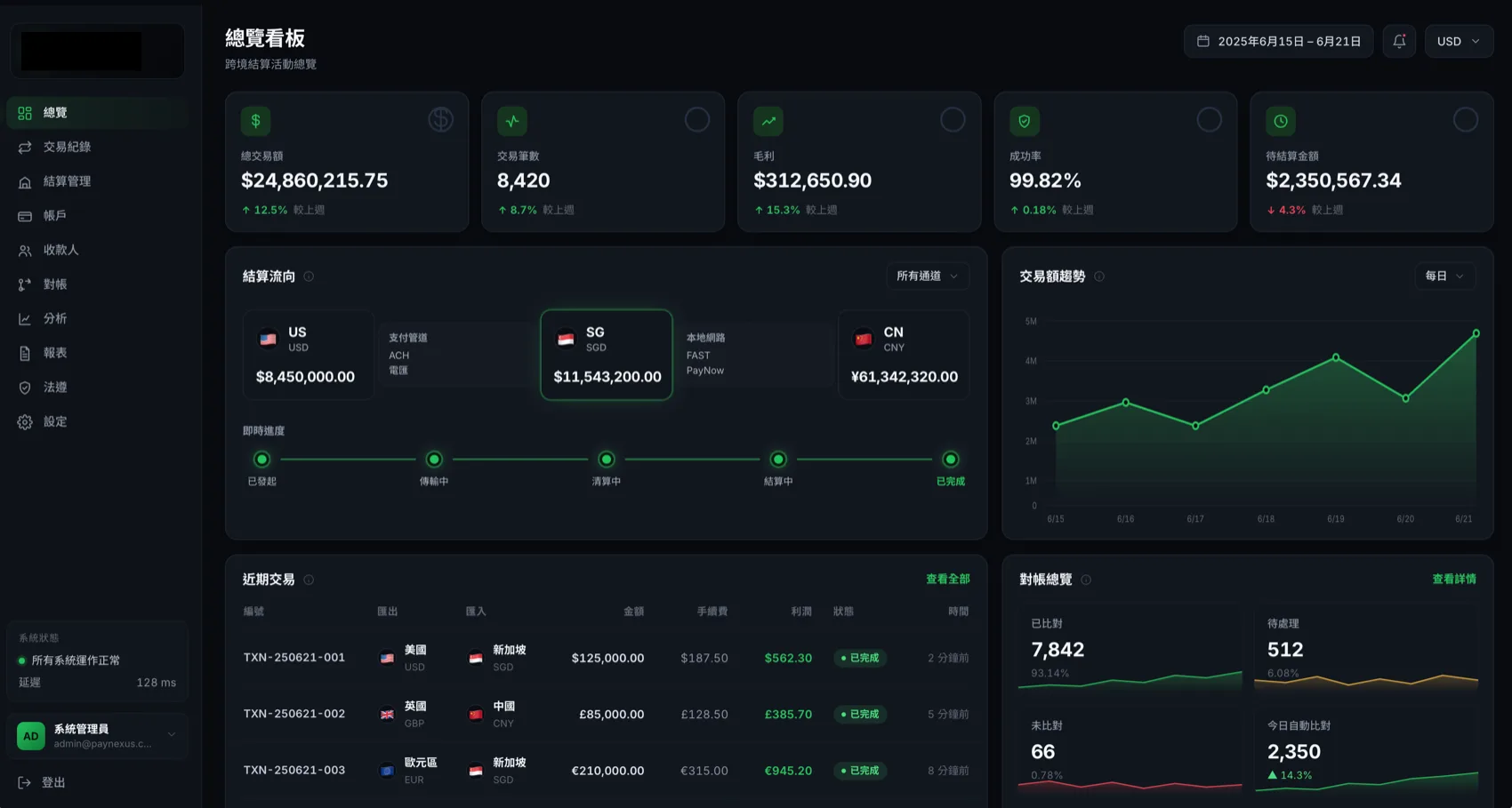
Built a unified gateway abstraction over all channels behind one API, an automated reconciliation engine with rule-based anomaly detection, and a merchant back office with live ledgers and settlement reports.
Process
Channel audit & reconciliation rules
Mapped each upstream channel’s API behaviour and statement formats, turned the reconciliation team’s mental rules into programmable matching logic, and defined tolerance bounds for amounts, fees and posting-time gaps — the engine is only as good as the rules it encodes.
Gateway layer & reconciliation engine
Wrapped every channel behind one interface — adding a channel later means writing one adapter. The engine pulls channel statements daily and matches them line-by-line against internal transactions; anything that does not reconcile lands in a review queue instead of being silently posted.
Parallel run & staged cutover
Ran the old manual process and the engine side by side, cutting over channel by channel only after several consecutive days of matching results. Risk rules and alerting went live last, so false positives could not muddy the cutover.
Deliverables
- Payment gateway API
- Auto-reconciliation engine
- Merchant back office
- Risk rules & alerting
- Settlement report exports
Results
- -90%manual reconciliation
- T+0settlement (was T+3)
- 50,000+transactions / day
FAQ
Yes. The value of automated reconciliation depends on how much manual effort it replaces, not on volume. The architecture scales with your channels and traffic — smaller operations can start with one channel and grow from there.
No — that is exactly what the gateway abstraction is for. Channel differences live in their own adapters, so a new channel means writing one adapter; the core order, reconciliation and risk logic stays untouched.
No. The rollout runs old and new in parallel: the engine reconciles alongside the manual process, channel by channel, and each channel only cuts over after consistently matching results. Bookkeeping never stops.
Have something similar in mind? Tell us about it
Start a projectThis case is anonymised to protect client contracts and privacy.