
Web3 approval security scanner
Wallet approval risk scanning with one-click revoke.
Custom Solutions
Challenge
Wallets accumulate token approvals for years — some to contracts later flagged as malicious — with no tool to surface the exposure and act on it quickly.
Solution
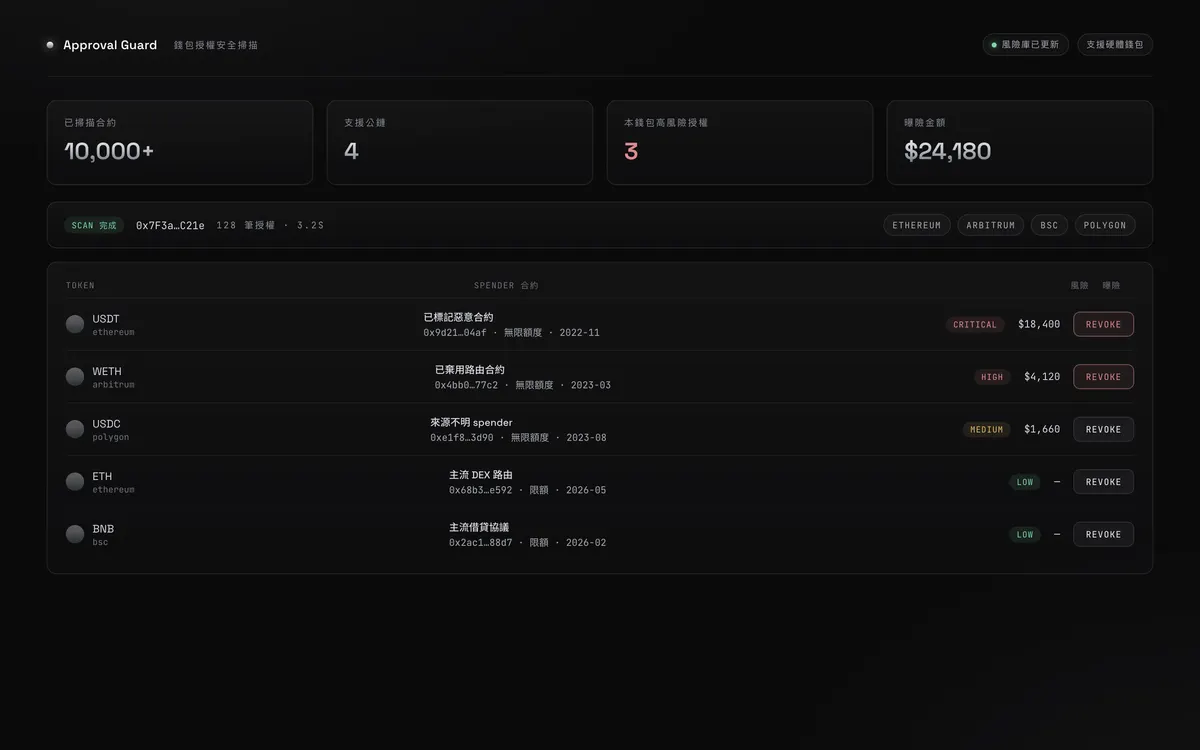
Built an on-chain approval scanner that cross-references a risk database, ranks findings by value at risk, and offers batched one-click revocation — multi-chain, hardware-wallet friendly.
Process
Risk database first
Aggregated multiple public malicious-contract feeds into a continuously updated risk database with confidence tiers — a scanner is only as good as the data behind it, so this came first.
Scanning engine & risk ranking
The engine walks a wallet’s approval history, computes the value each approval can move, and ranks findings by exposure. Chains share one scanning interface — each implements only its own lookup logic.
Revocation flow & signing safety
Batch revocation only composes transactions — private keys are never touched; signing happens in the user’s own wallet, hardware wallets included. The UI spells out exactly what each pending transaction does: no blind signing.
Deliverables
- Approval scanning engine
- Risk contract database
- Batch revoke UI
- Multi-chain support
Results
- 10,000+contracts scanned
- 4chains supported
- 0security incidents
FAQ
Never. Scanning reads only public on-chain approval records — a wallet address is all it takes. Revocation merely composes transactions; every signature happens in your own wallet, hardware wallets included. The tool has no signing capability at all.
They happen — which is why findings are tiered warnings, never automatic actions. Flags are ranked by source confidence and value at risk, each with its reason shown, and the revoke decision always stays with the user. The database updates continuously to narrow the error.
We do, under the same rules: never touch private keys, never sign on a user’s behalf, and always spell out what each transaction does — no blind signing. Security before features is why this project has a clean incident record, and it is our baseline for any on-chain work.
Have something similar in mind? Tell us about it
Start a projectThis case is anonymised to protect client contracts and privacy.